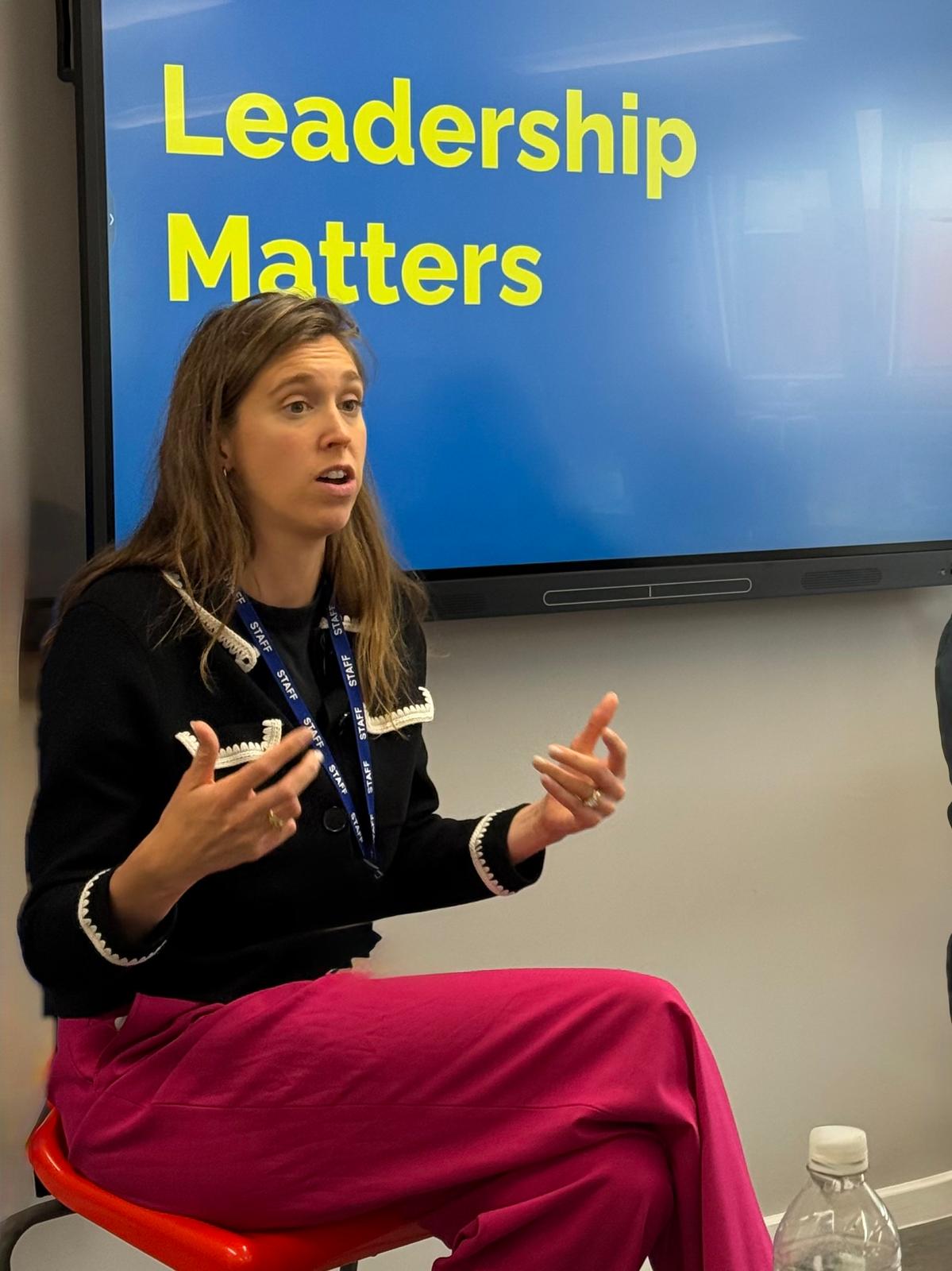
Tilly (Matilda) Browne worked as a teacher at Reach Academy Feltham since 2015, and as a Co-headteacher since January 2020. She also became the Co-headteacher of our brand new school, Reach Academy Hanworth Park when it opened in September 2024.

Opening New Schools
Over the past thirteen years, Reach Schools has opened two new schools for pupils aged 2-16 and a sixth form college in the heart of Feltham in west London. This has been driven by a strong vision to ensure that every child is equipped with the skills, attributes and academic qualifications to go on to enjoy lives of choice and opportunity.
A number of stakeholders were involved and collaborated to make this happen, to liaise with local authorities, secure funding and much more. All of that needed to happen before classrooms and spaces were built where pupils could learn and flourish. However, of course a school is about much more than its building. Each has its own unique atmosphere or culture: that feeling you get when you walk into a space is created by its people, staff, pupils, parents and the wider community you work in.
We invest significant amounts of time in creating and building our unique culture and we are really proud of it. It is a culture everyone is invested in. It is positive, it is warm and it is highly professional. One where we live and breathe our vision.
Everyone has to do Culture
Everyone has to do culture. I have heard staff say ‘I’m more of a curriculum person’ or ‘I’m more of a pastoral person’. Whoever you are, everyone has to do culture in a community if it’s going to stick. We expect everyone at Reach Schools to contribute to it and to build it every day.
Every single interaction is an opportunity to practise the positive culture of excellence that we live by in the classrooms, the hallways and our meeting spaces. Culture is inevitably led from and set by those at the top, from the Headteachers and through the Senior Leadership Teams. However, all staff need to contribute and reinforce it.
Moreover, culture is never done. Every single day we’re working on it, we need to practise it, reinforce it, show it and own it. We can’t expect new staff or pupils to automatically know and understand what we do. We need to teach them about our culture, how to ‘do’ it and how to maintain it. So how do we support our staff and pupils to effectively build culture?
Mental Models of Behaviour
Firstly, we are very clear about expectations and boundaries at Reach Schools. Pupils know how to behave towards others in and out of the classrooms. We do this by:
- Explicitly teaching behaviour and being clear about what we expect from students before they even step through our doors for the first time through home visits
- Continuing to practise key routines to build those habits
- Having predictable consequences for negative behaviour
- Creating positive social norms, in which pupils are rewarded
Teaching Behaviour
No one expects a four year old child to come into a classroom knowing the norms of how to behave in that context. The experience of a school environment is brand new to them and they may never have even stepped into a classroom.
It is our responsibility to teach them what good behaviour looks like at Reach. We start this during our home visits when we know they have accepted a place in Reception. Every pupil is visited by a staff member where pupil, parent or carer and teacher all sign our Whatever It Takes commitment, which includes our code of conduct. We clearly communicate what is expected of all three parties in the relationship between school, pupil and family and it sets a benchmark for expectations.
Once our pupils start school with us, we reinforce behaviour systems through assemblies and storytelling examples of how to behave. Importantly, we always explain why we have these expectations. More often than not, the why is connected to being able to do our best so that we can achieve our vision for all pupils. For example, we expect pupils to be ready to work at the beginning of the school day, so that not a moment is wasted in helping them to learn and to do their best.

Practising Key Routines
All of our expectations around being ready to work are practised regularly so that they become second nature. We have hand signals and abbreviations like *STAR and *TANC that pupils use every day to reinforce the importance of being ready to learn and to achieve. We inject joy into these routines so that they do not become repetitive. For example, we create competitions among form groups as to who is the quickest to get ready to work. The winners are rewarded with merits which go towards a termly points total. In this way, pupils are having fun and being given positive reinforcement, while also ensuring they are ready to learn as quickly as possible.
Predictable Consequences
Children feel safer if they know what is going to happen next and they need to know if they are doing the right thing or not. If they show any of our values, for example courage in speaking up in class, they know they will be rewarded. Conversely, if they aren’t trying their best or disrupting others, they know that there will be a consequence.
Creating Positive Social Norms
Every morning when our pupils arrive, we say ‘Good Morning’ and ask each other how we are today. So our first, and every interaction, starts with positivity and a smile. We expect everyone to open doors for each other. Teachers are called by their first names, not Sir or Miss, which other schools find unusual, but we love it. We believe it helps break down barriers between pupils and staff and contributes to our sense of Team Reach. We are all part of that team, with our shared vision.
We talk about teams a lot at Reach. We want to build collaboration within our classrooms to create that sense of working and achieving together. Rewards are team rewards: at the end of term the whole form is rewarded. Behind this is the idea that together we can build something really special.
Warm/Strict Approach
With all of the above, we follow what we call a warm/ strict rather than a ‘no excuses’ approach to behaviour in our schools. We are really clear about our predictable consequences and what we expect, while approaching everything we do in a kind and warm way. This helps us to build strong relationships with pupils and their families. It helps develop that sense of team.
Coaching Staff in Great Culture
We are really proud of our staff and the warm supportive community we have built, which we continue to work at every day. When new staff arrive to work here, they go for a walk around the local area with a family support officer. We want new staff to feel embedded within our community and to know where their families live so they can understand their pupils better. We also have regular training and coaching to embed the habits below that we expect from staff.
Core Habits
- Expecting, narrating and checking for 100%. Practically, that means pausing until we have 100% attention from the class.
- When correcting behaviour, we use a neutral tone and volume with emotional control.
- If a pupil isn’t showing the behaviour we expect, we break down and explicitly communicate the steps they need to take, so they have the opportunity to modify what they are doing.
Expert Habits
- Use the least invasive forms of intervention and circulation to stop low level disruption.
- ‘Narrate the positive’ to build momentum for active participation of all pupils.
- Use and practise consistent, structured routines to manage time and resources efficiently.
- Use ‘praise loud, fix soft’ to publicly build and narrate compliance as a norm.
- Build relationships based on trust, by assuming the best in interactions with pupils.
- Vary tone between correction, teaching and praise to build positive professional relationships.
- Anticipate your expectations clearly by using ‘positive framing’ when correcting or guiding pupil behaviour.
- Manage behaviour in line with the school’s behaviour policy to reduce conflict and prioritise learning.
- Use ‘precise praise’ to provide genuine, positive reinforcement.
All the above means that staff as well as pupils have social norms by which we behave and approach every interaction in and outside the classroom.
We love growing people
We love growing people at Reach Schools. Our staff need to strive for excellence if we expect our pupils to as well. As with our pupils, we can’t expect our teachers to be automatically amazing at living and breathing our culture. So we invest and support them with regular training to help them be the best they can be.
This is done in these key ways:
Deliberate practice
Four mornings a week, we get together for a very short time (literally five minutes) for deliberate practice. A senior leader will model a small technique to use in the classroom. It could be the STOP clap that we all use, it could be the scanning for 100%. Staff then practice it in pairs to ensure they know how to use it successfully and it becomes second nature in their work.
Some of these techniques come from the book *Teach Like a Champion, by Doug Lemov. It helps give clear alignment on how to approach the classroom dynamic and help build that positive culture. We believe these techniques become increasingly important as pupils move through the school and have more than one teacher. It gives consistency of expectations and how behaviour is managed, at whatever Key Stage they are in.
CPD
Our weekly CPD sessions focus on building staff’s mental models. Over the course of an hour, we work on why we need to adapt our practice or what we can all do to more effectively teach our children and thus enable them to make rapid progress.
Staff Mentors
Every single teacher at Reach Schools has a mentor or coach. They meet for half an hour every week following a ten minute class observation. Staff are given specific granular action steps from the meeting that they can implement in their very next lesson.
Live Coaching
Live coaching is when staff ‘live coach’ a colleague to support and mentor them. For example, they might see others dealing with situations that they perceive may not be positively contributing to our culture. Anyone in the building can have ‘on stage’ or ‘offstage’ live coaching.
On Stage Coaching
This is when the staff member talks directly to the children to help correct what is happening. For example, a teacher has asked for silence but doesn’t have 100% from pupils. We could say, ‘Team, I just heard Tilly asking for silence, it’s really important that we’re all doing the same thing so we can learn really well.’
Off Stage Coaching
This is when we would speak directly to a teacher. For example, maybe they have set a task without enough clarity of expectations of voice levels and so there is some whispering from pupils which makes it harder to concentrate. We would say to the teacher, ‘Can I just check whether children are in silence or can use soft voices?’ This gives the teacher the chance to reset their expectations.
Challenges of Building a Great Culture
Growth has been the biggest challenge in building a great culture here at Reach Schools. At the beginning, with smaller groups of children and staff, it is easier to maintain. With a full, all-through school of 840 two to eighteen year olds, it becomes harder due to sheer numbers, which is why we invest so much in staff training.
Culture Reboots
Lastly, keep it fresh. Keep innovating and tweaking systems and processes to ensure that culture is maintained and constantly improving. We make a point of rebooting our culture every September. After the long summer break, we need to re-energise staff and pupils. So at our INSET days we will spend time in periods of deliberate practice ensuring pupils on the first day experience clarity and consistency.
Are you interested in training to become a fantastic teacher with Reach?
If you’re interested in getting into teaching, why not train with us and learn how to be an excellent teacher? Reach Teacher Training offers both QTS and PGCE and QTS and PGCE together and classroom experience is either in our schools or in the local Borough of Hounslow. Click here for more about Reach Teacher Training.
Would you like to see more of what we do? Check out our blogs at Reach Out, our community of educators where we share, collaborate and grow.
Glossary:
*STAR: Sit up straight, Track the speaker, Arms on the table, Resources Down
*TANC: on Time, Accurate, Neat, Complete
*TLAC: Teach Like A Champion: book by Doug Lemov.


